 If you were referred by one of our Partners, including those that might be a Club, Rescue or any other Cause or Organization, please enter the "id code" they shared with you into the box below as needed.


From Secretariat to Mineral Balance: The Work of Dr. Thomas Swerczek
If you’ve been reading my emails or following me for a while, you’ve probably heard me mention my late friend Dr. T.W. Swerczek, DVM, PhD more than once.
And if you’re newer here, you may reasonably wonder:
Who was he, and why do I keep talking about him?
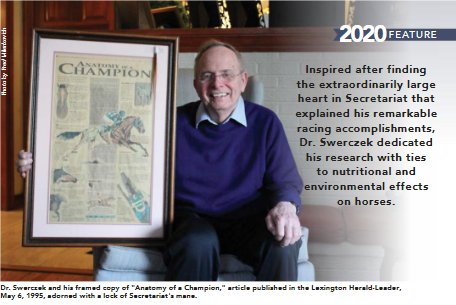
Dr. Thomas Swerczek with a framed copy of “Anatomy of a Champion,” a feature published in the Lexington Herald-Leader on May 6, 1995. His examination of Secretariat became part of Secretariat’s remarkable story, but the work Tom continued doing through the years involving nutrition, environmental stress and mineral balance is another reason I still share his work today.
You May Know Part of His Story Already
Dr. Swerczek was a veterinary pathologist and longtime professor and researcher at the University of Kentucky.
He was also the veterinary pathologist who performed the necropsy on Secretariat after the great champion died in 1989.
What he found became part of Secretariat’s remarkable story.
Secretariat had an extraordinarily large, healthy heart. You’ll often see it described as a “22-pound heart,” but it was not actually weighed during Secretariat’s necropsy. That figure came later as Dr. Swerczek’s estimate, after examining other horses and gaining additional points of comparison.
Years later, Tom continued to talk about that remarkable finding and what it might tell us about the extraordinary physiology of one of the greatest champions.
In 2020, a feature titled “Secretariat, Twice the Heart: Veterinarian Swerczek Shares the Untold Story” allowed him to revisit that experience and much more.
But Secretariat’s Heart Isn’t Really Why I Keep Talking About Tom
That part of his story is fascinating.
But what has stayed with me through the years is where Tom’s observations and research kept taking him.
He spent decades looking deeper into what was happening inside animals when something outside didn’t seem right.
Among the relationships he studied were:
- Sodium
- Potassium
- Calcium
- Magnesium
- Nitrates
- Pasture and forage conditions
- Environmental stress
- Grass tetany
- Reproductive loss
- Broader electrolyte and mineral imbalance
Some of that work challenged conventional thinking.
Tom’s observations led him to look beyond magnesium alone when considering grass tetany and related problems. He explored how sodium, potassium, nitrates, calcium, magnesium, pasture conditions and environmental stress could interact rather than looking at any one mineral or symptom in isolation.
That is one of the reasons his work interested me so much.
Looking Beyond the Symptom
For years I’ve said:
“Focus on the cause, not the symptoms.”
Tom approached many problems with much the same curiosity.
A horse may present with one obvious problem, but that doesn’t necessarily tell us where the problem started.
What is happening in the pasture?
What is happening nutritionally?
What is happening with sodium?
What are nitrates doing?
Are calcium and magnesium being affected?
What changed with weather, forage or stress?
Those are bigger questions than simply asking what product might address a symptom.
And those bigger questions are why I’ve continued sharing Tom’s work.
Last Week We Looked at One Piece of That Puzzle
Last week I shared more specifically about Dr. Swerczek’s work involving mineral balance, sodium, nitrates, calcium, magnesium and the bigger picture surrounding grass tetany.
If you missed that discussion, you can read it here:
Beyond Grass Tetany: What Dr. Swerczek’s Research Can Teach Us About Mineral Balance
That discussion goes deeper into one particular area of his work.
Today I wanted to back up and explain something broader: why I keep bringing his name into these conversations in the first place.
A Man Who Kept Asking “Why?”
It’s interesting that many people remember Dr. Swerczek because of something extraordinary he found inside perhaps one of the most famous horses who ever lived.
I remember him for that too.
But I also remember a man who kept looking deeper into the everyday problems affecting horses and other animals.
He kept studying.
He kept asking questions.
He kept looking for relationships that weren’t always obvious at first glance.
And after all these years, that still seems worth talking about.
Because whether we’re discussing Secretariat, grass tetany, pasture changes, minerals or everyday animal health, the lesson remains much the same:
Don’t stop at what you can see. Keep asking what may be causing it.
That’s something Tom understood.
And it’s something I still believe today.
~Dr. Dan


